

No products in the cart.
What microcontrollers are compatible?
It works with Arduino, PIC, and AVR microcontrollers via GPIO pins.
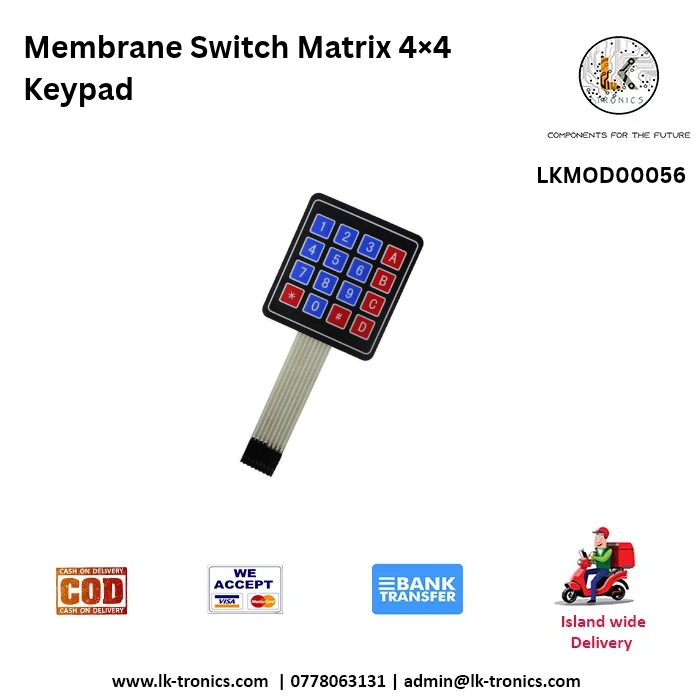
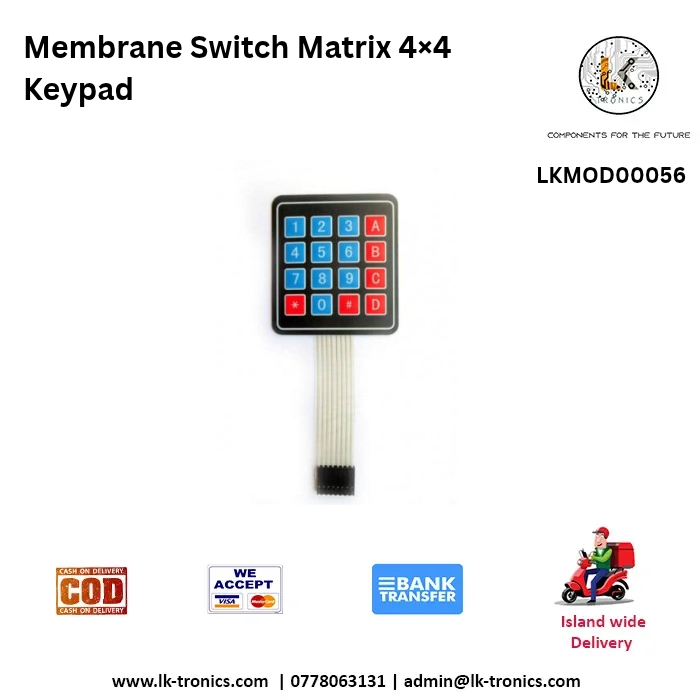
The 4x4 membrane switch matrix is an ultra-thin, low-profile human-machine interface (HMI) input device featuring 16 momentary tactile push buttons arranged in a four-row by four-column ($4 \times 4$) matrix grid. Featuring standard telephone-style characters (0–9, A–D, *, and #), this keypad provides an intuitive data-entry and menu-navigation interface for microcontrollers, smart digital door locks, access control systems, security alarms, and instrumentation.
Constructed with flexible, multi-layered polyester and printed conductive silver traces, the keypad operates completely passively without requiring an external operating voltage or dedicated driver IC. Multiplexing 16 individual switches into an 8-wire bus (4 row lines and 4 column lines) reduces the GPIO overhead on the host microcontroller from 17 pins down to just 8 digital I/O pins. Equipped with a peel-and-stick 3M self-adhesive backing and a flexible flat cable (FFC) terminating in a standard 2.54 mm (0.1″) pitch 8-pin female header, it mounts flush onto project enclosures, front panels, and development breadboards.
VISIT OUR FACEBOOK PAGE FOR MORE INFO | MORE PRODUCT IN OUR SHOP
You must be logged in to post a review.
It works with Arduino, PIC, and AVR microcontrollers via GPIO pins.
This 4x4 matrix keypad features 16 total keys for various inputs.
It operates reliably between 3.3V and 5V DC for diverse projects.



There are no reviews yet.